 Sometimes you get a call to re-commit to a spiritual passion. Sometimes the religion of your parents surprises you with its rich potential. Its symbols deepen, and open meanings for you.
The prophet Isaiah received such a call, mid-career. When I first read his account, it looked and sounded…well…a bit plagiarized.
Once, in the wilderness, Moshe saw an angel in the heart of a flame. In the palace of heaven, Isaiah sees God surrounded by fiery angels.
Moshe said, “I cannot be a leader, because my lips are blocked.” Isaiah says, “I cannot be a prophet, because my lips are not pure.”
When God called, “Moshe, Moshe,” Moshe answered, “Hineni – Here I am!” When God asks, “Whom shall I send?” Isaiah answers, “Hineni – Here I am, send me!”
If you want to be cynical, you could say that Isaiah was doing a bit of exaggerated self-promotion.
If you want to be generous instead, you could remember that a prophet is not a blank slate. The prophet has a personality, a life experience, and a way of thinking. Prophetic insight appears in thoughts, feelings, and images drawn from the prophet’s own symbolic system. Moshe was Isaiah’s model of a prophet; the burning bush was his model of a prophetic call.
For me, too, a spiritual re-call has appeared in familiar forms.
About fourteen years ago, my husband Charles and I were living in North Carolina, “Buckle of the Christian Bible Belt,” in a home built on the old Billy Graham family farm. My spiritual experiences began to shift. God seemed to be knocking on a closed door inside my mind. But I was afraid to open the door. “What if I open the door,” I asked Chas,”and it’s Jesus? If this is my truth, I’m prepared to deal with it…but how will I explain this to my parents?” Wisely, Chas said, “What you receive will be in the symbols familiar to you. Open the door.”
Seven years later, I was ordained as a rabbi.
Franz Rosenzweig, early 20th century German Jewish philosopher, also received his call in a familiar form.
Rosenzweig was a well-adjusted young man with a strong social network. He was close with his parents. He sent them postcards filled with his young adult philosophical musings. They read the all cards and saved them. He was close with his friends, discussing his deepest spiritual musings honestly and openly. He loved and he was loved.
Together with his cousins, he studied Christianity. Together they prepared to convert together. (Obviously, this was not a problem in his family.) To better understand the Jewish roots of Christianity, Rosenzweig attended a Kol Nidre service. There he had a mystical experience.
Out of this experience, he became one of the founders of the Jewish Studies movement, combining Jewish tradition with critical academic thinking.
He never described his personal mystical experience, but he did describe his understanding of the Revelation at Mount Sinai.
He summarized it in one word: “Love.”
And he connected it with one word from the Torah: anokhi.
The first word spoken by God at Mount Sinai is anokhi – I am. Rosenzweig thought that anokhi – I am – was the only word God actually spoke.
With that word, God presented the Divine Self. God offered the Divine Presence in complete openness, as a lover opens up to the beloved. About the immediate, overwhelming experience of love, there isn’t much to say. Words are after-the-fact rationalizations that don’t quite capture the moment.
At Mount Sinai, wrote Rosenzweig, people simply fell in love with God. The other 9 1/2 utterances at Sinai, the other 612 mitzvot of the Torah, are only after the fact rationalizations that don’t quite capture the moment.
Rosenzweig thought that love was an experience beyond symbols, and perhaps it sometimes is. But for him, it was also a symbolic form that held God’s presence.
The Talmud tells a story about Rav Yossi finding himself re-called through familiar symbols as well.
It is early in the fourth century C.E. The Roman emperor Constantine has converted to Christianity. The Christian version of Jewish of post-Temple Jewish spiritual renewal is gaining ground. It seems Rav Yossi’s brand of spiritual renewal, Rabbinic Judaism, is not.
Rav Yossi finds himself traveling through Jerusalem. It’s time to pray, so he ducks into the ruins of a building.
There meets the prophet Eliyahu (Elijah).
Eliyahu says, “You don’t have to enter a ruined holy site, you know. You can pray right where you are in the present.”
That in itself is enough of a teachable moment: Move forward with your project, Rav Yossi. Stop looking backwards at the ruins and wailing.
Rav Yossi doesn’t seem to grasp the metaphor, so Eliyahu continues. “What sound did you hear in the ruins?”
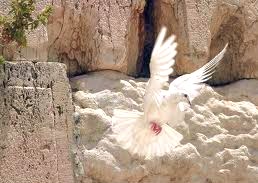
Rav Yossi says, “I heard the cooing of a dove.” Focusing only on the mournful sound of the dove’s voice, Rav Yossi imagines the dove is wailing. He continues, “It sounded like God was saying, ‘Woe to you my children, whose lack of unity led to the destruction of the Temple.’”
