
Isaiah’s animals, a phone call during COVID, and the work of hope
Words offered on the topic of “hope,” the theme at a recent Multifaith Action Society gathering
At interfaith gatherings, we make connections that help us in difficult times. We meet colleagues who join with us for political advocacy, people with skills in helping communities through conflicts, people willing to serve as ambassadors in showing what is possible.
We also meet people who help us in extraordinary circumstances. When COVID pandemic restrictions began, a Muslim colleague called me and said, “Your burial customs are similar to ours. How is your Jewish community managing them right now?” Because I had led a funeral for the first member of our community to die of COVID, I was able to answer the question. My Muslim colleague and I spoke of our sadness, and our shared need for the wisdom to help others.
Today, I would like to speak about hope using an image from our biblical tradition. This is from the prophet Isaiah, chapter 11. (The English translation is mine.)
A wolf shall visit with a lamb, a leopard lie down with a kid; a calf, a lion, and a steer together, and a little child shall lead them. A cow and a bear shall graze, their young lie down together, and a lion, like an ox, shall eat straw. A baby shall play over a viper’s lair, and over an adder’s den a toddler shall extend its hand. No one will do evil or destroy anywhere on my holy mountain, for the land shall be filled with knowledge of the Ineffable One as water covers the sea.
Who are these animals? And what do they usually mean in biblical poetry?
The wolf is the violent invader. The lamb is the conquered one. In this vision, the two make a new treaty. The conquering wolf becomes a respectful guest and lives humbly in the land.
The cow and the bear are bereaved mothers. The cow is the domestic cow we know well. So often her babies are taken from her. The bear always appears in prophetic poetry as a furious mother in search of her cubs. In this vision, the two bereaved mothers get together, and they say, no more violence. They raise children together, laying the foundation for a new generation.
The lion and the ox are both violent animals in biblical literature. The lion threatens and roars; the ox rampages and gores. There’s a lot of talk in the Bible about making sure your ox is restrained. So, if you properly care for your ox, it becomes a helpful working partner. And maybe that can be true of the lion, too. In this vision, everyone learns to calm themselves, to still their reactivity, and to work together.
And then, the land fills with a stillness that the prophet Isaiah calls “knowledge of the Ineffable One.” A pause in violence. A sense of inner peace to hold us as we negotiate our conflicts.
So, borrowing the prophet’s language for hope:
I find hope when I see sincere efforts at Truth and Reconciliation in Canada.
And when grieving people stand up together and say, we cannot be enemies; this has to stop—as so many do in Israel and Palestine.
And when children see multicultural friendship as natural, as my own children do.
And when each of us realizes there is a spirituality that is bigger than any particular tradition—as so many interfaith activists understand.
May this spirituality fill us as we work for the good of our beautiful land, its peoples, and its creatures.
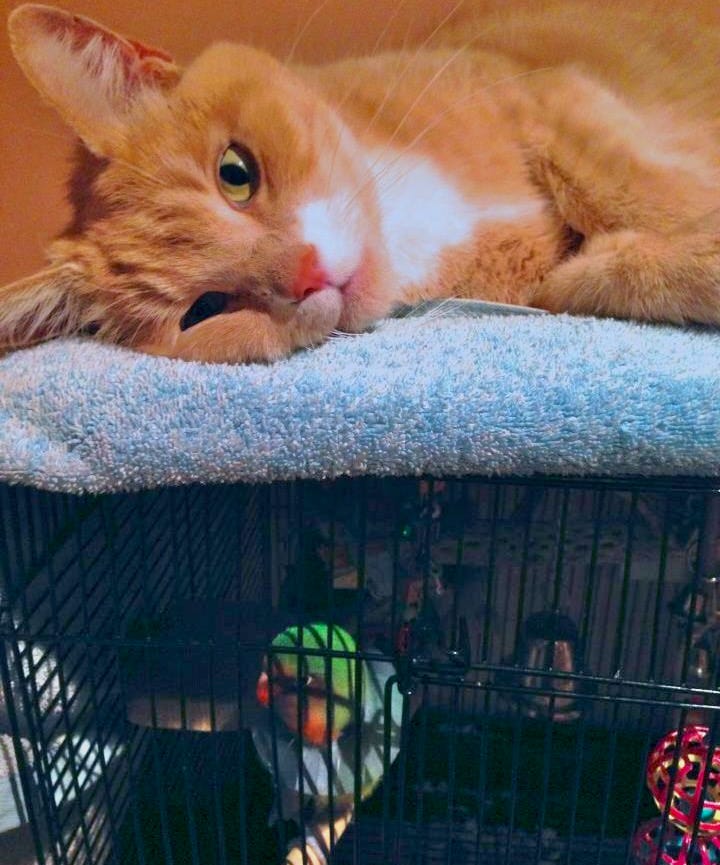
Find a more detailed analysis of Isaiah’s vision in the final chapter of my book Mouth of the Donkey: Re-imagining Biblical Animals. Or learn more about Vancouver’s Multifaith Action Society. Photo of Koi-Cat and Buddy-Bird, friends with boundaries, by Laura Duhan-Kaplan.
