
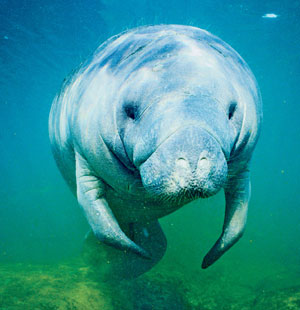
 Dugong, dugong, it’s the cow of the sea…
Dugong, dugong, also known as the manatee
It doesn’t have wings – that would be silly
Doesn’t live in a tree – that would also be silly
Compared to the dolphin, its very close cousin
It’s quite ugly – so very ugly!
Click here to listen to this song in its original context. And read on for a very different perspective.
***
I first learned of the existence of manatees in 1989. My new boyfriend Charles took me to Florida to meet his parents, and we enjoyed a one-day detour to the Everglades National Park. Florida has 15,000 square kilometers of fragile marshland, and 4,000 of them are protected by the U.S. National Park Service. Everglades National Park has few trails, but many watercourses. Its purpose truly is conservation rather than recreation. About 1200 endangered manatees live in Florida, and many take shelter in the estuaries of the Everglades.
Charles and I visited the Everglades at the very end of the era that allowed airboats in the watercourses. An airboat is a flat-bottom metal boat propelled by an airplane propeller. The first airboat, built in Nova Scotia in 1905, was called the “Ugly Duckling,” and modern designs have not improved.
Charles is extremely comfortable and skilled around all kinds of boats, so he romantically insisted we rent one and ride around the Glades. The water is so rich in tannin from the mangrove trees that it is black. From your boat, you cannot see into the water at all. So, as you can imagine, Charles ecstatically enjoyed the water, the wind, and impressing me with his boating skills…while I shivered in terror, absolutely positive we were going to harm a manatee. (We did not.)
Boating accidents are actually the greatest threat to manatees in Florida. Manatees are aquatic mammals who live in shallow water, both saltwater and freshwater. They are large and long-lived – a seventy-year old manatee might weigh 1200 pounds (550 kilos). Biologists describe their intelligence as comparable to dolphin intelligence. Manatees are calm underwater vegetarians, with a very specialized diet of shallow-water plants. They hear high-frequency sounds very well, but they can’t hear the low-frequency hums of a motorboat; hence, their vulnerability.
Last week I was with my mother, a retired animal activist. For no particular reason, I was reading her December issue of Sierra Magazine. And I came across an article about manatees, called “Thou shalt not smite thy manatee.” The article was about an incident in Kings Bay, Florida, and it reported:
“After two endangered manatees were killed last year, the U.S. Fish and Wildlife Service proposed making the bay a manatee refuge, where boat speeds would be greatly reduced. That set off the Tea Party. ‘We cannot elevate nature above people,’ local leader Edna Mattos told the St. Petersburg Times. ‘That’s against the Bible and the Bill of Rights.’”
I’ve studied the U.S. Bill of Rights, and I am fairly certain it doesn’t say anything about either nature or speedboats.
But bringing up the Bible leads us to Parshat Terumah, which has a lot to say about nature.
Torah teaches that the Israelite community offers many gifts of the heart towards the building of the Mishkan (traveling wilderness sanctuary). One gift is called in Hebrew orot techashim, skins of the tachash, which were used to cover the mishkan. Translators have struggled with the word tachash for at least a thousand years. Options include ermine, dolphin, narwhal, zebra, badger, okapi, seal, antelope, giraffe, and – I am not making this up – rainbow joy.
The prevailing contemporary favorite seems to be dugong. An astute reader might ask, “Where in the desert did the Israelites get the dugong skins?” The 12th century commentator Rashi offers a mystical answer: this multicoloured animal came into existence for the purpose of building the mishkan, and then disappeared. However, this question does not require a mystical answer. Dugong do live in the Red Sea, and the Israelites must have done a good bit of trading to supplement their shepherding economy.
Still, there is quite a bit to be said in the mystical department.
I accept the midrashic view that every item used in building the mishkan was chosen for its existential vibration or its symbolic meaning. So I will offer my favorite interpretation of the vibe of the dugong skin.
Among his many oracles, the prophet Yechezkel channels a love-poem from God to Israel. The short version is something like this: “I found you lost and alone in the desert. I dressed you in embroidered cloth, and sandals made of tachash.” (Ezekiel 16:10) This looks very much like a poetic allusion to the mishkan’s woven walls and tachash leather roof. So one midrashic author suggests that the Israelites gave God a spiritual wedding gift of tachash skins, which God fashioned into sandals and gave as gift in return. Or, in other words, tachash is a symbol of love. The manatee vibe is the vibe of love.
Love, expressed through the peaceful intelligence of the manatee, encircles and protects everyone who sets foot in the mishkan.
Wouldn’t you want to protect a powerful animal whose presence offers such a profound teaching? Surely, if someone asked you to, you wouldn’t respond with, “But I need to water ski twelve months a year right in Kings Bay!” – which, by the way, is what Ms. Mattos means by “We cannot elevate nature over humans.”
I’ve wondered why it bothers me so much when I hear some people talk about how human beings are superior to other animals. Perhaps I’m annoyed by the desire to get credit simply for being what we are, and not really on the basis of any merit.
But why should that annoy me? I believe very strongly in the midrashic teaching that the tachash is a symbol of love. The mishkan holds God’s presence, and God’s presence is love. We don’t do anything to earn it. We are simply loved in a continuous exchange of gifts. These gifts are always available if we turn our attention towards them – even though I know that turning is not always easy.
So, perhaps what annoys me is more like this: I wish that being held in the security of love would confer a kind of nobility. If you experience an abundance of love, then there are some kinds of scarcity you shouldn’t have to fear. I wish people could know this, share more and grasp at less.
Every animal, vegetable, or mineral plays a role in our planetary ecosystem. Many species do the work of maintaining our habitat for us – billions of dollars worth of work each year, as we would know if we had to do it ourselves. Ideally, we should pay each of them in a currency meaningful to them, something that cultivates or enriches their environment. But instead, we just keep appropriating. We keep naming ourselves “owners” of places and creatures, and paying each other in our own currency.
The mishkan reminds us how silly this artificial system is. Really, the world is a gift that invites us to give gifts in return. It doesn’t belong to us any more than it belongs to the manatee. Sure (says another midrash), for the mishkan we donated our gold, silver, copper, blue, purple, ram skins and tachash skins. Their value comes from their beauty. And their beauty reminds us of the roof of the world: the golden sun, the silver moon, the western horizon at sunset, the brilliant sky at noon, the rain clouds, thunder and lightning.
Everything we have to give comes from the magnificent world that houses us.
Image: www.sierraclub.com, Atsushi Sakurai/Minden Pictures
Sources: Wikipedia, U.S. Park Service website, Sierra Magazine, JPS Mikraot Gedolot, Soncino Midrash, Nathan Slifkin’s Sacred Monsters, E.O. Wilson’s The Creation.
Biological clarification: Scientifically, the words “manatee” and “dugong” name subspecies of the order Sirenia; in common conversation, they are often conflated. People who have not visited their habitats tend not to know very much about either of them.
Dear Reb Laura,
Love this post. Manatees are a favorite of mine – we have a number of rescues at the Columbus Zoo and my folks life on Sanibel Island, where the Center for Rehabilitation of Wildlife (CROW) is an island gem and favorite of my family.
I approached T’rumah this week from the awesome love-fest of DLTI/Isabella Freedman on Shabbat Mincha and in my home kehilla in Columbus, Ohio, where we drew fewer than a minyan this morning. Feeling lost in the wilderness, and enlivened my Torah.
Thanks, as always, for your vividly inspiring and creative approach!!
LOL about Charles impressing you with his ability to handle boats. Also about the BIll of rights line. BTW have you read Dominion by Scully? He’s a real right winger (speechwriter for shrub) who actually investigates this question of the relationship of nature and humans from a religious point of view.
Thanks for sharing as always
If only the manatees could hear lower frequency rumblings, they’d listen for boats coming and swim away from them, especially boats driven by people like Ms. Mattos. They would know their lives depended on it. As for Ms. Mattos, it’s kind of clear what sort of stuff she listens to and parrots; I don’t know how you could get her to hear voices beyond her own, even if her soul depended on it. People say self-centered things when they don’t feel listened to. That, or she’s just a jerk!