

When cosmic consciousness fades, the inner work begins.
Here is something the great prophets teach us. Seeing God doesn’t automatically make you a better person. It can inspire you and fill you with light. But the light fades. And then the real work begins.

When we meet Moshe in Parshat Ki Tissa, he is already an accomplished prophet. He heard God’s voice at the burning bush. He reached past his fears and confronted Pharaoh. He set up a sacred space around Mt. Sinai so people could hear God’s voice. He climbed the mountain, saw God, and had a meal by the sapphire floor under the divine throne. And then he learns that the people reject God. In his rage, he executes 3,000 people.
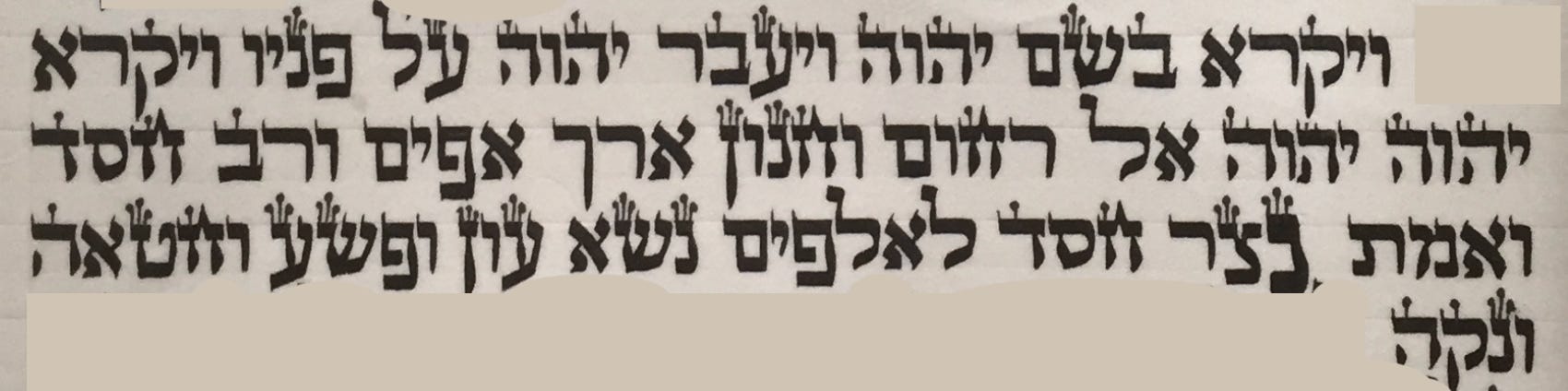
And now, Moshe is back on Mt. Sinai, fasting and meditating for 40 days. He asks God, “Please show me who you really are.” God says, “No one can look upon me and live. But I will show you my back, my aftereffects, what happens when I pass through.” And then, the text says, Vayikra! A voice calls. Maybe it’s Moshe’s voice, maybe it’s God’s voice. It recites what we now call the Thirteen attributes. “God, God, compassionate, gracious, patient, full of love and truth…” Adonai, Adonai, El Rachum v’Chanun, Erekh Apayim v’Rav Chesed v’Emet.
Moshe is filled with a luminous energy. When he comes down from the mountain, his face shines with a light so strange, people don’t want to see it. So, for a while, Moshe needs to wear a veil when he’s around other people.
But the glow fades, and so does Moshe’s grounding in compassion. When he’s under stress, his old ways come back. He’s enraged when people challenge him or his community. He authorizes a brutal, (arguably) unprovoked war against the Midianites. So, God tells him: you are not going to the land flowing with milk and honey.
We see some parallels in the story of Mohammed’s first revelation, as told in the Hadith, Islamic sacred story collections. Mohammed runs a small import export business at a regional trading post. All kinds of people do business there. The traders know respect is good for business. So, anyone who comes through is free to place an image of their God in the community shrine. Mohammed is also interested in religion—especially Judaism and Christianity—and he learns from his family and his clients.
Each evening, Mohammed meditates in a quiet cave. One evening he feels something pressing so hard into his chest that it takes his breath away. He hears an angelic voice say, three times, “Iqra—recite! Call out!” And Mohammad begins to recite. “Proclaim in the name of your Lord, who created humans and taught them.” Mohammed is terrified, but his wife and her cousin help him interpret his spiritual experience.
Mohammed keeps meditating and receives more revelations. Including this one, “In the name of God, most compassionate, most merciful!” Bismillah ir-Rahman ir-Rahim. Mohammed’s vision of God’s unity and compassion fills him up. So, he starts to preach. He criticizes the business community for its polytheism, and its neglect of widows and orphans. A few people like the message and form a spiritual community. But most business people don’t want to hear the message. Some of them attack Mohammed. So, he spends years defending his community and attacking others—creating more widows and more orphans.
How can we make sense of this? Both these prophets teach so beautifully about divine compassion. And both stray from that vision to inflict terrible violence.
Prophets and teachers are not God. They are only human. So, they might glimpse God, feel God’s compassionate presence, and teach about it wisely. But compassion is not necessarily their essence. They can and do become distant from it; they can and do act without it. And thus, they teach us an important lesson.
A mystical insight, a revelation of divine oneness and compassion, is not the pinnacle of a journey. It is just a beginning. It’s a glimpse of a consciousness we might reach for. To reach it, we need reminders.
Here is one tool that I use to help me remember. Every evening, I breathe slowly and deeply while I recite the thirteen attributes of compassion. I have been doing this for 18 months now. And finally, I have come to associate slow deep breathing with compassion, grace, patience, love, and truth. When I need to embody those attributes, I breathe deeply.
Maybe you love these prophetic teachings about compassion, too. What do you do to hold them close?
Written for a class I am teaching in interfaith studies at ALEPH Ordination Program, the Jewish Renewal Seminary. The course is called “Deep Ecumenism.” Top photo: Mountains seen from Mountain View Cemetery by Laura Duhan-Kaplan.
