

A hornet, a Hebrew verb, and the creatures who helped make the world
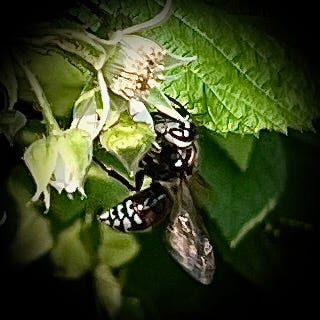
One morning, I am at the Grind Café on Main Street. I’m trying to get some writing done. But I get distracted by a loud buzzing. A bald-faced hornet is trying to get back outside. It flies, rests, flies, rests, and finally crawls down along the window and hides behind the table.
So, oddball that I am, I lean over the table’s edge and I look directly into the hornet’s face. And I say, “Hi, beautiful! The window isn’t safe. Here, climb on my notebook.” Immediately the hornet crawls up onto the table and makes a beeline for the notebook. Then, it settles on the middle of a page, and it waits. So, I say, “I don’t know where you live. You’ll have to tell me.” I carry the notebook outdoors, to a quieter street. I show the hornet a flower. Not interested. Grass. Not interested. Soil. Nope. Finally, I bring the notebook to a tree trunk. “Yes, that’s right!” the hornet says, in body language. It walks off the notebook and quickly climbs the tree.
And I am blown away by the wisdom of this little creature.
Where is wisdom?
Proverbs 8 is one of my favourite texts. Wisdom is there at the beginning, a partner in creation. As an amon, the Hebrew says: an artisan, a teacher, a faithful companion to the Holy One of Blessing (Prov. 8:22-31). And that makes sense. Of course, our Creator made the world with wisdom.
But in the familiar creation story at the beginning of Genesis, wisdom is not a character. So, we might ask, where is she? How does she show up in the story?
Here is one possible answer:
The Creator makes the world in partnership with its wise creatures. Wisdom shows up as the wisdom of the first creatures.
I offer this answer as a teacher in the Earth-based Judaism movement. We are teachers who love the land and its creatures. We also love the Torah, the Hebrew Bible, so we read the Hebrew carefully. We pay attention to the nuances of every word.
Wisdom of the Creatures
So, let’s take a careful look at some of the words in Genesis chapter one, that beautiful, orderly, poetic account of creation.
When the world is nothing but waters below—rivers and oceans—and waters above—clouds—how does dry land get created? God asks the waters to gather in one place, so the land can be seen. And the waters gather.
How do plants come to be? God asks the land to bring forth sprouts and grains and fruits. And the land makes itself fertile.
So, the creatures themselves are partners in creation. God does not specify every detail but invites each creature to be an amon: an artisan, a teacher, a faithful companion.
On the sixth day, God says, “Let us make a human in our image.” To whom is God speaking? Maybe God is speaking to the creatures. The light and the sun, the dark and the stars, the water and the fish, the land and the plants, the birds and the bugs and the mammals. God says, let’s create one more companion in our image. Someone whose life will be shaped by what we can provide.
But about that creature, God says something shocking. Something that contradicts the whole tone of the creation story. The humans yirdu. In most English translations: the humans will rule (Gen. 1:26). This makes no sense: that a creature so dependent on others would rule.
But Hebrew is more nuanced than English. The verb yirdu can mean “rule and dominate” and it can mean “descend,” “go down.” So, when God says the humans yirdu, all the meanings come into play. The dependent humans have a choice. They can rule in an anxious, exploitative way, and sink down morally. Or they can look down, humbly, at the foundation offered by fellow creatures, respect their wisdom, and live in a truly interdependent way.
That’s what the hornet taught me. It knew exactly what it needed, and exactly how to talk to me. Humbly, I paid attention, asked for its wisdom, and cared about its answers.
And maybe that is also what Wisdom herself teaches. “I stand at the city gates, and I call to everyone. Don’t be foolish. Wisdom is here. Wisdom has been here since the earth itself came to be. All you need to do is pay attention” (Prov. 8:1-5).
Photograph by Laura Duhan-Kaplan. The text is a revised, shortened version of a sermon I offered at St. Thomas Anglican Church, Vancouver, September 6, 2026
